
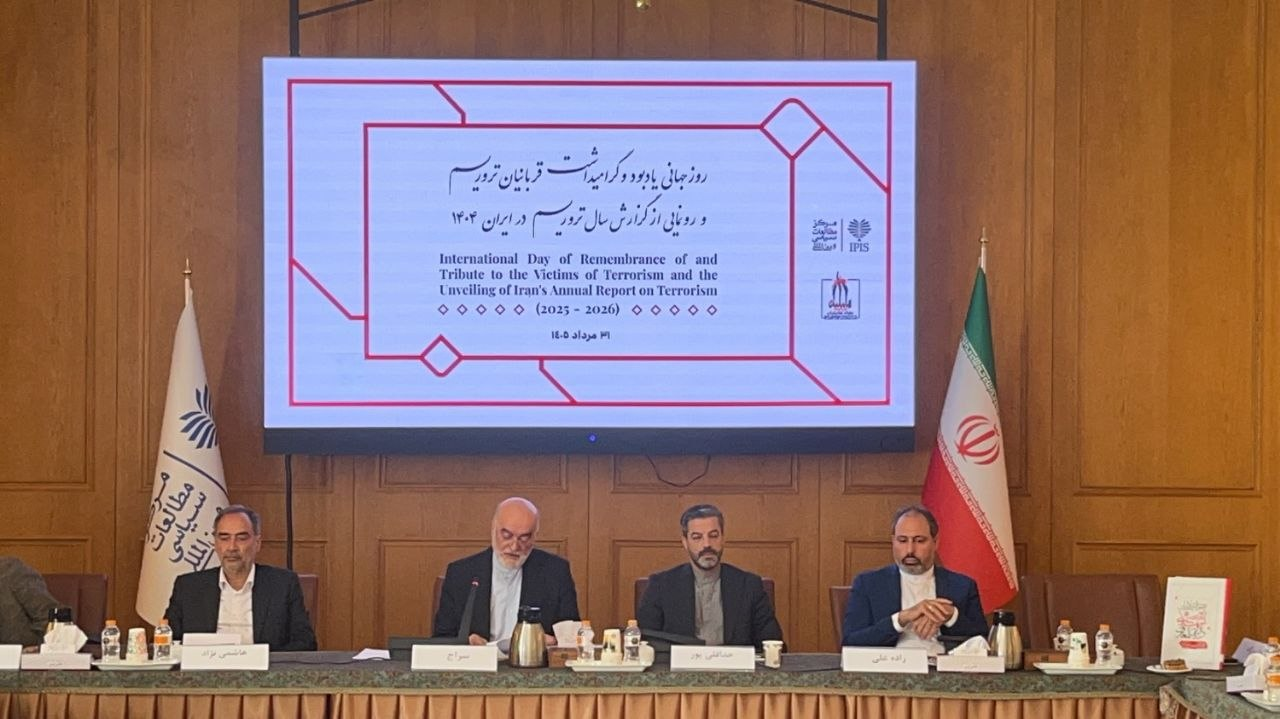
 Nasser Seraj, deputy for international affairs of Iran’s Judiciary and secretary of the High Council for Human Rights, said thousands of Iranian citizens—including children, women, men and the elderly, from ordinary civilians to officials, scientists, military and law-enforcement personnel, clerics, workers and students—have lost their lives in terrorist attacks.
According to Habilian, citing IRNA, Seraj said at Saturday’s ceremony that terrorism does not end with the death of a single person. “From the moment terrorism targets a human being, it enters the life of a family, and sometimes its effects remain for generations,” he said. “A bullet may take a person away from their family in a matter of seconds, but the suffering of that family can continue for years.”
He continued: “A child who has lost a father, a mother who has lost a child, a spouse who has lost a life partner, and a family that feels the absence of a loved one at its table year after year are all victims of terrorism. From this perspective, the victim of terrorism is not only the person who has lost their life; terrorism can victimize a family, a society and sometimes an entire generation.”
Seraj said that by designating August 21 as the International Day of Remembrance of and Tribute to the Victims of Terrorism, the United Nations had emphasized the need to support victims, preserve their dignity and guarantee their fundamental rights and freedoms. “But the fundamental question is whether the international community treats all victims of terrorism equally in practice,” he said. “Is the blood of every victim valued equally? Are the voices of all bereaved families heard to the same extent? And is our definition of terrorism independent of the power, wealth, nationality and political standing of those who perpetrate it? Unfortunately, the answer to these questions is not always yes.”
The Judiciary official said Iran is a country that has suffered from terrorism and that the Islamic Republic and the Iranian people have paid a heavy price over recent decades as a result of repeated terrorist attacks.
Seraj said terrorism in Iran has taken different forms: “At times it has appeared as bombings in public places; at other times as assassinations of political and scientific figures, attacks on defenseless people in streets and public gatherings, or operations intended to spread fear, insecurity and distrust throughout society.”
Silence and Narrative-Building Around Terrorist Attacks on Iranian Citizens
He added: “Alongside all these incidents, one issue that must not be forgotten is how the international community deals with the perpetrators and supporters of terrorism. If a terrorist attack takes place in a European country, it immediately becomes a global issue. But when the victim is Iranian, reactions are sometimes extremely limited. If a political official is assassinated somewhere in the world, it is described as a threat to international peace and security. But when the victim is an Iranian citizen or schoolchildren in Minab, the same incident may be met with silence, justification or even politically constructed narratives. This is the double standard that must be discussed frankly.”
Seraj stressed: “If human rights are universal, their observance must also be universal. If human life has inherent value, that value cannot depend on a passport. An Iranian child, a Palestinian child, a European child, an African child and an Asian child are all children. An Iranian mother who loses her child experiences the same grief as a mother anywhere else in the world.”
Military Power Cannot Be a License to Violate Human Rights
Addressing state terrorism and state responsibility, Seraj said counterterrorism should not focus solely on non-state groups. “The international community must adopt a consistent position toward any organized use of violence against civilians, regardless of the identity of the perpetrator. If an armed group targets one or more civilians, that act must be condemned. Military power cannot be a license to violate human rights. Membership in a political alliance cannot confer innocence, and claiming to fight terrorism cannot justify targeting ordinary people.”
Fundamental Principles of International Humanitarian Law Must Be Respected
Turning to war and civilian victims, Seraj said recent conflicts had again shown how ordinary people can be exposed to the direct consequences of military confrontation. “During the 12-day war and later the 40-day war, as well as the events in Hormuz, ordinary citizens, families, children, women and the elderly were exposed to attacks and insecurity,” he said. “In such circumstances, the issue is not only the number of victims; the central question is the need to respect the fundamental principles of international humanitarian law.”
No Military Objective Can Justify the Killing of Children
Referring to the principle of proportionality in armed conflict, Seraj said: “The principles of proportionality and of taking necessary precautions to protect civilians are not principles that can simply be set aside under certain circumstances. One painful example is Shajareh Tayyebeh School in Minab. A school should be a place of education, hope and building the future—not a scene of children’s deaths. When a child becomes a victim of violence at school, regardless of the political or military dispute underway, humanity is facing a tragedy. No political cause, geopolitical dispute or military objective should destroy the dignity, security and lives of children.”
He said the international community should investigate such incidents, establish the facts and, where violations of international humanitarian law are confirmed, pursue accountability for those responsible.
Support for Victims Must Go Beyond Symbolic Sympathy
Seraj emphasized that victims must not be forgotten. “One of our most important responsibilities is to prevent victims from being forgotten. A victim of terrorism and their family must not be left alone once the immediate incident is over.”
He continued: “Victims need legal, psychological, economic and social support, while their families need access to justice. Above all, victims must feel that society sees them and hears their voices.”
The Judiciary official said United Nations documents and approaches also stress this principle. “Support for victims must not be limited to symbolic expressions of sympathy; it must address their immediate, short-term and long-term needs. Families of victims are present at this ceremony today, and each has a story—a story of loss, of waiting, and of an empty place in the family. Perhaps their most important request is simply: do not forget our loved one. Everyone must hear that voice.”
The International Community Should Apply a Single Standard in Counterterrorism
Calling for an end to double standards, Seraj said: “We expect the international community to apply a single standard in the fight against terrorism. There should be no ‘good’ or ‘bad’ terrorism, no Eastern terrorism and Western terrorism. State and non-state terrorism cannot be defined according to political interests.”
He added: “Any act that creates fear and terror, kills civilians, and deprives people of security and peace should be condemned regardless of the perpetrator or political motive. Political, financial, military and media support for those responsible for terrorist acts must also end. Failing to speak about victims’ rights while remaining silent in the face of the perpetrator or supporter of violence is a contradiction that weakens public trust in the international human-rights system.”
Referring to the death of Iran’s Supreme Leader during the recent attacks, Seraj said: “Assassination occurred at the highest political level. Even the highest level of the Islamic Republic was not immune from the consequences of violence. Ayatollah Seyed Ali Khamenei, the Leader of the Islamic Republic of Iran, was killed during the attack, and several members of his family were also killed.”
Human Lives Are Not Bargaining Chips
Seraj stressed: “If we accept double standards, we undermine justice. Our message is therefore clear: terrorism must be condemned wherever it occurs and whoever commits it. Human lives are not political bargaining chips. The rights of victims cannot be subject to discrimination, and no power should regard itself as being above responsibility for human life.”
He continued: “We hope for a day when no family loses a loved one to terrorism or violence; no child becomes a victim of war or political conflict; and no human being is targeted because of nationality, religion or political views. We hope justice replaces revenge and dialogue replaces violence. On that day, remembrance of victims of terrorism will not only recall tragedy; it will also symbolize humanity’s victory over violence. We bow in respect before all victims of terrorism and their patient, bereaved families.”
Seraj concluded: “Victims of terrorism are not merely part of the past. They are part of our conscience today, and their memory reminds us that if we normalize violence, there will be another victim tomorrow.”